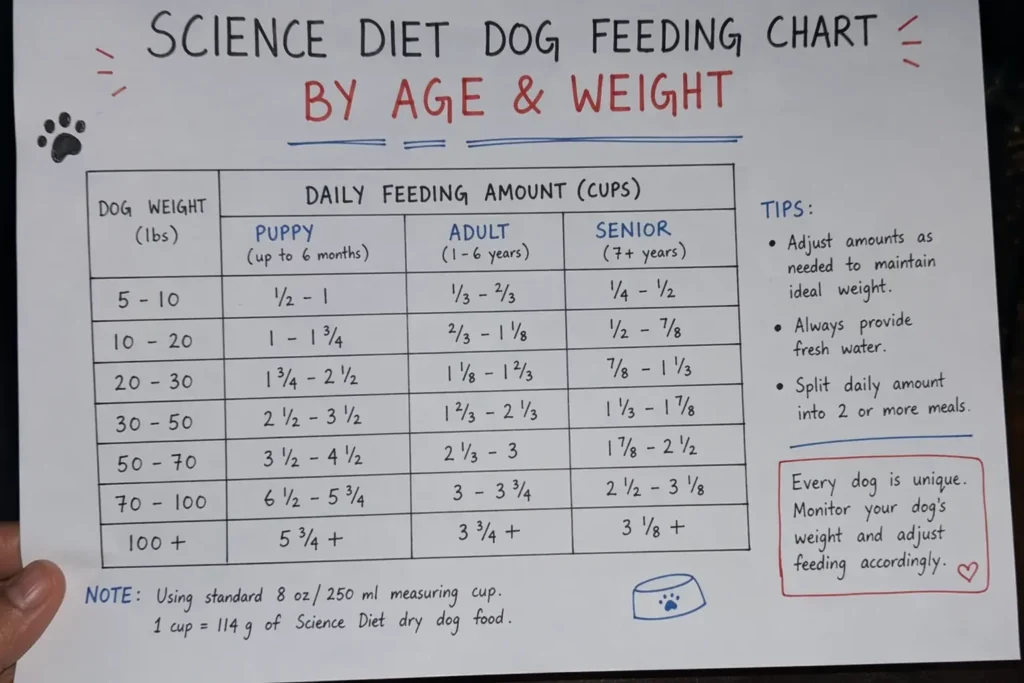
How much Science Diet should you feed your dog? A 10 lb adult dog needs about ¾–1 cup/day. A 30 lb adult needs 1¾–2¼ cups/day. A 60 lb adult needs about 3 cups/day — always split into 2 meals. Adjust ±10% for activity level and consult your vet for health conditions.
Why a Science Diet Feeding Chart Actually Matters
Most dog owners eyeball portions — and this single habit is the #1 driver of canine obesity. According to the Association for Pet Obesity Prevention, over 56% of dogs in the U.S. are overweight or obese. The consequences aren’t just cosmetic: excess weight shortens lifespan by up to 2.5 years and increases risk of diabetes, joint disease, and heart issues.
Hill’s Science Diet feeding charts are built from AAFCO-standardized animal feeding tests — meaning the amounts aren’t arbitrary. They’re calibrated to the specific caloric density of each formula (typically 340–420 kcal/cup for dry food), ensuring your dog gets exactly the nutrients they need — no more, no less.
Overfeeding Risks
Obesity, diabetes, joint strain, reduced lifespan. Even 10% excess calories daily causes significant weight gain over months.
Underfeeding Risks
Malnutrition, muscle loss, stunted growth in puppies, weakened immune system, low energy.
Science Diet Advantage
AAFCO-certified, #1 vet-recommended brand. Each formula tailored to life stage with clinically-tested nutrient ratios.
Before adjusting your dog’s diet, consult these authoritative sources used by veterinarians worldwide:
- AVMA (American Veterinary Medical Association) — Find a licensed vet near you
- AAFCO.org — Official pet food nutritional standards & label guidance
- VCA Animal Hospitals — Free pet nutrition articles by board-certified vets
- PetMD — Vet-reviewed dog nutrition and feeding calculators
Feeding by Life Stage: What Changes & Why
Science Diet offers distinct formulas for each life stage because nutritional needs change dramatically as dogs age. Using the wrong formula — or the wrong amounts — is a common and costly mistake.
Hill’s Science Diet recommends 4 meals/day for ages 6–12 weeks, reducing to 3 meals/day from 3–6 months, then 2 meals/day from 6 months onward. Always use a puppy-specific formula (Science Diet Puppy, Puppy Small Bites, or Puppy Large Breed) — never adult food for growing dogs.
Puppy Feeding Frequency Guide
Science Diet Adult formula provides approximately 363 kcal/cup (Chicken & Barley Recipe). Portions are primarily determined by body weight, with adjustments for activity level. Use measuring cups — never estimate by eye.
Many senior dogs benefit from slightly smaller portions (10–15% less) than their adult peak — but nutrient density should remain high. Science Diet 7+ contains ActivBiome+ to support digestion and immune health as organ function naturally declines.
Science Diet Feeding Charts by Weight
The tables below provide general daily feeding amounts based on body weight. Divide the total into 2 meals per day for adult dogs, or 3–4 meals for puppies under 6 months. All amounts are in cups of dry kibble.
🐶 Puppy Feeding Chart (Science Diet Puppy Formula)
Based on Hill’s Science Diet Puppy — approx. 380 kcal/cup. Divide daily amount across 3–4 meals.
| Dog Weight | Daily Amount | Per Meal (3x) | Per Meal (4x) | Best Formula |
|---|---|---|---|---|
| Under 10 lbs | ¾ cup | ¼ cup | ~3 tbsp | Science Diet Puppy Small Paws |
| 10–20 lbs | 1¼ – 1½ cups | ½ cup | ⅓ cup | Science Diet Puppy Small Bites |
| 20–40 lbs | 2 – 2¾ cups | ⅔ – ¾ cup | ½ cup | Science Diet Puppy |
| 40–70 lbs | 3 – 3¾ cups | 1 – 1¼ cups | ¾ cup | Science Diet Puppy Large Breed |
| 70–100 lbs | 3¾ – 4½ cups | 1¼ – 1½ cups | ~1 cup | Science Diet Puppy Large Breed |
🐕 Adult Dog Feeding Chart (Science Diet Adult Formula, 1–6 yrs)
Based on Science Diet Adult Chicken & Barley — approx. 363 kcal/cup. Split into 2 daily meals.
| Dog Weight | Daily Amount | Morning Meal | Evening Meal | Calories/Day (est.) |
|---|---|---|---|---|
| 5–10 lbs | ½ – ¾ cup | ¼ cup | ¼ – ½ cup | ~180–270 kcal |
| 10–20 lbs | ¾ – 1¼ cups | ⅓ – ½ cup | ⅓ – ¾ cup | ~270–450 kcal |
| 20–30 lbs | 1¼ – 1¾ cups | ⅔ cup | ⅔ – 1 cup | ~450–635 kcal |
| 30–50 lbs | 1¾ – 2½ cups | ¾ – 1 cup | 1 – 1¼ cups | ~635–908 kcal |
| 50–70 lbs | 2½ – 3 cups | 1¼ cups | 1¼ cups | ~908–1090 kcal |
| 70–90 lbs | 3 – 3½ cups | 1½ cups | 1½ cups | ~1090–1270 kcal |
| 90–110 lbs | 3½ – 4¼ cups | 1¾ cups | 1¾ – 2 cups | ~1270–1540 kcal |
🦴 Senior Dog Feeding Chart (Science Diet 7+ Formula)
Based on Science Diet Adult 7+ Chicken Meal, Barley & Rice — approx. 340 kcal/cup. Feed 2 meals/day.
| Dog Weight | Daily Amount | Morning Meal | Evening Meal | Special Notes |
|---|---|---|---|---|
| 5–10 lbs | ½ – ¾ cup | ¼ cup | ¼ – ½ cup | Small Paws 11+ for tiny breeds |
| 10–20 lbs | ¾ – 1 cup | ⅓ – ½ cup | ⅓ – ½ cup | Monitor for weight gain |
| 20–40 lbs | 1¼ – 1¾ cups | ⅔ cup | ⅔ – 1 cup | Joint support key at this size |
| 40–60 lbs | 2 – 2½ cups | 1 cup | 1 – 1¼ cups | Senior Vitality for active seniors |
| 60–90 lbs | 2¾ – 3¼ cups | 1⅓ cups | 1⅓ – 1½ cups | Large Breed Senior formula preferred |
The most accurate way to know if you’re feeding the right amount isn’t a chart — it’s a Body Condition Score (BCS). Vets use a 9-point scale where 4–5 is ideal. You can learn the system from:
- WSAVA Body Condition Score Chart (PDF) — International gold standard
- VCA Hospitals: Body Condition Scores Explained
- Rib test: You should feel ribs with slight pressure but not see them. If you can’t find them, your dog may be overweight. If they protrude visibly, increase food.
Science Diet Formula Comparison: Which One Is Right?
Choosing the wrong formula is as problematic as feeding the wrong amount. Here’s how Hill’s Science Diet’s key dry dog food lines compare side by side.
| Formula | Life Stage | Kcal/cup | Key Benefit | Vet Rx? | Best For |
|---|---|---|---|---|---|
| Adult (Chicken & Barley) | Adult 1–6 yrs | ~363 | Balanced maintenance, ActivBiome+ | No | Healthy adult dogs, all sizes |
| Puppy | Puppy 0–12 mo | ~380 | DHA, high protein, bone growth | No | Growing puppies (med/large breeds) |
| Puppy Small Bites | Puppy 0–12 mo | ~380 | Smaller kibble for small mouths | No | Small/toy breed puppies |
| Puppy Large Breed | Puppy 0–18 mo | ~363 | Controlled calcium for bone growth | No | Labs, Goldens, German Shepherds |
| Adult 7+ | Senior 7+ yrs | ~340 | Brain function, joint & immune support | No | Dogs entering senior years |
| Adult Perfect Weight | Adult 1–6 yrs | ~292 | Lower calorie weight management | No | Overweight adult dogs |
| Small & Toy Adult | Adult 1–6 yrs | ~370 | Small kibble, small breed metabolism | No | Dogs under 25 lbs |
| Large Breed Adult | Adult 1–5 yrs | ~338 | Joint support, controlled phosphorus | No | Dogs 50 lbs+ |
| Prescription Diet (i/d, r/d, k/d…) | All ages | Varies | Therapeutic nutrition | Yes ✓ | GI issues, kidney, liver, weight disease |
Adjusting Portions for Activity Level
The feeding charts above are baseline estimates for a moderately active dog. Your dog’s actual lifestyle should fine-tune the amounts. Use the guide below as a starting point, then monitor body condition weekly.
Sedentary / Low Activity
Indoor dogs, older dogs, post-surgery recovery. Reduce portions by 10–15% from chart amounts. Check body condition monthly.
Moderate Activity
Daily walks, regular play. Use chart amounts as-is. This is the baseline these recommendations are built on.
High Activity / Working Dogs
Agility dogs, hunting dogs, herding breeds. Increase portions 15–25% or switch to a higher-calorie formula. Monitor for weight loss.
Pregnant / Nursing
Switch immediately to Science Diet Puppy formula. Increase portions by up to 50–75% during nursing. Always consult your vet.
- Always use a measuring cup — not a coffee mug or scoop. Even ¼ cup daily difference adds up to 2,700 extra calories per month for a 40 lb dog.
- Weigh your dog every 2 weeks at home or at your vet. Adjust food by 5–10% if weight deviates from ideal.
- Always provide fresh water — Hill’s recommends unlimited access. Kibble dogs need more water than wet-food-fed dogs.
- Count treats as calories — treats should make up no more than 10% of daily caloric intake. Adjust meals accordingly.
- Mixing wet & dry? Reduce dry by ¼ cup for every 3 oz of wet food to keep daily calories balanced.
How to Transition Between Science Diet Formulas
Switching formulas abruptly — even within the same brand — can cause digestive upset, loose stools, and food refusal. Hill’s recommends a 7-day gradual transition for all formula changes.
🔄 The 7-Day Formula Transition Plan
When to Switch Life Stage Formulas
| Breed Size | Switch Puppy → Adult | Switch Adult → Senior |
|---|---|---|
| Toy / Small (under 20 lbs) | 9–12 months | 10–12 years |
| Medium (20–50 lbs) | 12 months | 7–9 years |
| Large (50–90 lbs) | 12–18 months | 6–8 years |
| Giant (90+ lbs) | 18–24 months | 5–6 years |
Warning Signs You’re Feeding Too Much or Too Little
Feeding charts are starting points. Your dog’s body sends clear signals. Learn to recognize these so you can course-correct before health issues develop.
- Can’t feel ribs without pressing firmly
- Loss of visible waist when viewed from above
- Fat deposits over hips or at tail base
- Reluctance to exercise, tires quickly on short walks
- Waddling gait or difficulty rising
- Heavy panting with minimal activity
- Ribs and hip bones visibly protruding
- Always acting hungry, food-obsessive behavior
- Dull, brittle coat or dry skin
- Low energy, lethargy, weight loss
- Eating grass, stool, or non-food items
- Puppies growing slower than expected for breed
If you notice either set of signs, don’t self-adjust aggressively. A 5–10% portion change per week is the safe rate. Consult your vet if your dog shows rapid unexplained weight changes — this can indicate thyroid, metabolic, or gastrointestinal conditions unrelated to portion size.
Not Sure Which Science Diet Formula Is Right?
Use Hill’s free Pet Food Finder — answer 3 quick questions about your dog’s age, size, and health to get a personalized recommendation backed by veterinary science.
→ Use Hill’s Pet Food FinderFrequently Asked Questions
Ready to Feed Your Dog Right?
Bookmark this guide, pick the correct Science Diet formula for your dog’s life stage, and start measuring accurately today. Your dog’s health is worth the extra 30 seconds at mealtimes.
→ Browse Science Diet Dog Formulas
We’re the dedicated team behind MyPawSafe.com, with over a decade of combined experience in veterinary care, pet emergency response, and animal behavior. While we prefer to let our work speak for itself, our mission is clear: to provide science-backed, vet-approved advice that helps pet owners prevent accidents and save lives.