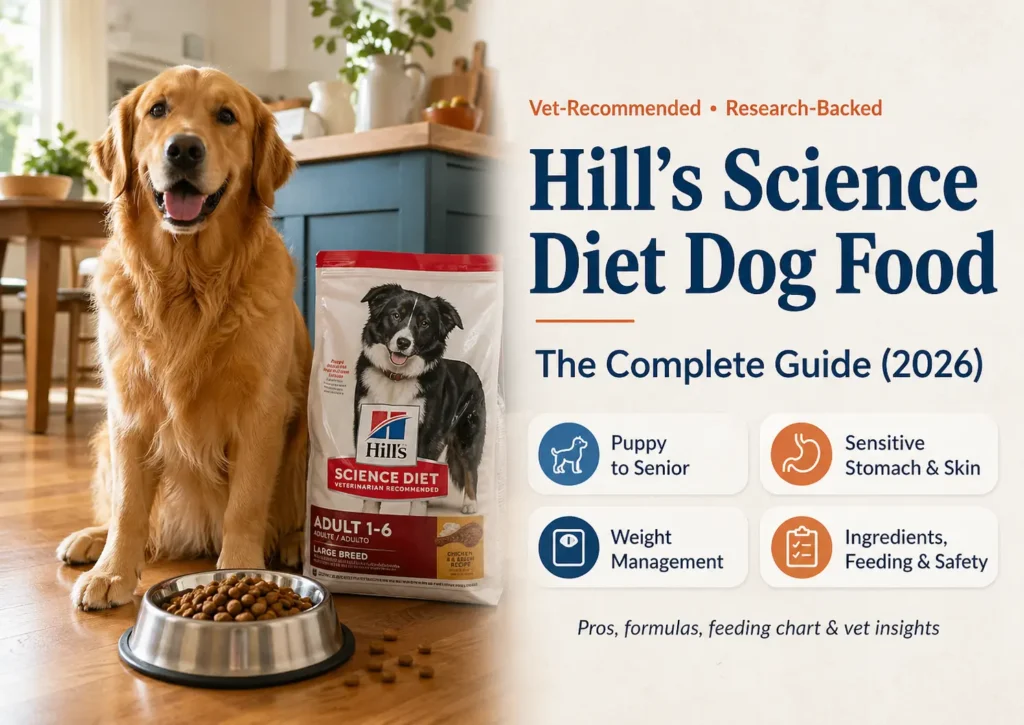
Hill’s Science Diet is a premium, vet-recommended dry and wet dog food brand made by Hill’s Pet Nutrition. It is formulated with real meat as the first ingredient, clinically studied nutrients, and passes AAFCO feeding trials. It is best suited for owners who prioritize veterinary science over marketing hype. The main trade-offs are a higher price point and use of corn/wheat in some formulas. For most healthy dogs — puppies through seniors — it is a safe, reliable, and research-backed choice.
1. What Is Hill’s Science Diet?
Hill’s Science Diet is the flagship retail line from Hill’s Pet Nutrition, a subsidiary of Colgate-Palmolive founded in 1939. The brand was originally developed by veterinarian Dr. Mark Morris Sr. to create nutritionally complete, clinically studied pet food. Today, it’s the #1 vet-recommended dry dog food brand in the United States according to Hill’s own market data and independent surveys.
The Science Diet line covers every life stage — puppies, adults, and seniors — as well as special health needs like sensitive stomachs, weight management, oral care, and small/large breeds. It is distinct from Hill’s Prescription Diet, which requires a veterinarian’s prescription and is designed to manage diagnosed medical conditions.
out of 5
out of 5
out of 5
out of 5
out of 5
Science Diet is sold over-the-counter for healthy dogs. Prescription Diet manages specific diseases (kidney, bladder, heart, GI) and requires a vet’s prescription. If your vet recommends a “Hill’s diet,” confirm which line they mean. Read our full comparison: Science Diet vs Prescription Diet →
The Nutritional Philosophy Behind Science Diet
Unlike many pet food brands that lead with marketing (“grain-free,” “ancestral diet,” “raw-inspired”), Science Diet leads with nutrition science. Hill’s employs over 220 veterinarians, PhD nutritionists, and food scientists, and the brand claims its formulas are developed through AAFCO feeding trials — the gold standard for pet food validation — not just nutrient analysis alone.
This research-first positioning is why most veterinary schools in the U.S. use Hill’s products in clinical nutrition curricula. It also means the formulas are conservative — they include tried-and-tested ingredients with documented safety records rather than novel, trendy proteins that haven’t been studied in feeding trials.
↑ Back to top2. Science Diet Ingredient Deep Dive
Understanding what’s actually in your dog’s food is the most important step in evaluating any brand. Here is a breakdown of the key ingredients found across Science Diet’s adult dry formulas, plus what each one means for your dog’s health.
Primary Protein Sources
Most Science Diet dry formulas list chicken or chicken meal as the first ingredient. Chicken meal is a concentrated protein source (with moisture removed) that often provides more actual protein per pound than whole chicken, which is mostly water. The brand also offers formulas featuring beef, lamb, salmon, and tuna.
Nutrients at a Glance (Adult Chicken Recipe)
The FDA has been investigating a potential link between grain-free diets (heavy in legumes like peas and lentils) and dilated cardiomyopathy (DCM) in dogs since 2018. Science Diet’s grain-inclusive formulas largely avoid this risk. If your vet recommends grain-free for your dog, discuss DCM risk with a board-certified veterinary cardiologist first. See Science Diet’s grain-free option →
Want to Verify the Science Yourself?
These authoritative sources are where veterinary nutritionists and cardiologists go for current peer-reviewed guidance on dog food, ingredients, and health claims:
Source note: Nutrient values are approximate, based on Hill’s published guaranteed analysis for Science Diet Adult Chicken Recipe. Always verify current values on the product bag as formulas may be updated.
↑ Back to top3. All Science Diet Product Lines Explained
Science Diet offers an extensive range organized by life stage, size, and health need. Here is a clear overview to help you find the right category for your dog before diving into specific formulas:
| Product Line | Life Stage | Key Benefit | Format | Our Review |
|---|---|---|---|---|
| Puppy | Puppy (all breeds) | DHA from fish oil for brain & eye development | Dry + Wet | Read → |
| Puppy Large Breed | Puppy (50+ lbs adult) | Controlled calcium for joint-safe growth | Dry + Wet | Read → |
| Puppy Small & Mini | Puppy (<25 lbs adult) | Small kibble, higher calorie density | Dry | Read → |
| Adult 1–6 | Adults 1–6 years | Balanced everyday nutrition, lean muscle support | Dry + Wet | Read → |
| Adult 7+ | Seniors 7+ years | Joint support, easy digestion, vitality blend | Dry + Wet | Read → |
| Sensitive Stomach & Skin | Adults | Prebiotic fiber + omega-6 for gut & skin | Dry + Wet | Read → |
| Perfect Weight | Overweight Adults | Clinically proven weight loss in 10 weeks | Dry + Wet | Read → |
| Adult Light | Adults (weight control) | Lower calories, higher L-carnitine | Dry | Read → |
| Oral Care | Adults | Interlocking fiber technology for tartar control | Dry | Read → |
| Small & Mini Paws | Small breed adults | Smaller kibble, optimized for small dog metabolism | Dry + Wet | Read → |
| Large Breed Adult | Adults 50+ lbs | Glucosamine & chondroitin for joint health | Dry | Read → |
4. Science Diet Puppy Formulas Reviewed
Puppies have fundamentally different nutritional needs than adult dogs — more protein for muscle growth, DHA for brain development, and carefully balanced calcium-to-phosphorus ratios. Here is what you need to know about each Science Diet puppy option.
Puppy Chicken & Brown Rice (Dry)
Real chicken as #1 ingredient. DHA from fish oil supports brain and eye development. AAFCO feeding trial verified. Ideal for most breeds under 50 lbs adult weight.
Read Full Review →Puppy Large Breed Dry
Specifically calibrated calcium and phosphorus levels for large & giant breed controlled growth. Prevents developmental orthopedic disease. Best for dogs expected to exceed 55 lbs.
Read Full Review →Puppy Small & Mini (Dry)
Smaller kibble size for tiny jaws. Higher calorie density for fast-metabolism small breeds. DHA included. Great for Chihuahuas, Yorkies, Toy Poodles.
Read Full Review →Puppy Chicken & Rice (Wet)
Higher moisture content supports hydration. Great for picky eaters or puppies transitioning from mother’s milk. Can be mixed with dry kibble.
Read Full Review →Feeding a large breed puppy a standard “puppy” formula can cause too-rapid bone growth, increasing the risk of hip dysplasia and elbow dysplasia. Always use a formula specifically labeled “Large Breed Puppy” if your dog is expected to exceed 55 lbs as an adult. See Large Breed Puppy Wet option →
5. Adult Formulas Reviewed
The adult range is Science Diet’s most expansive, covering ages 1–6 with options for all sizes, sensitivities, and health goals.
Adult 1–6 Core Lines
✓ Strengths
- AAFCO feeding trial verified
- Real chicken as first ingredient
- Excellent omega-6:3 ratio
- Widely available (Walmart, Petco, PetSmart, Amazon)
- Strong digestion track record
✗ Weaknesses
- Contains corn/wheat (controversial)
- Higher price than store brands
- Lower protein % than some rivals
- Limited novel protein options
Specialty Adult Options Worth Knowing
Sensitive Stomach & Skin
Prebiotic fiber + vitamin E. Best for chronic loose stools or dull coats.
Oral Care
Kibble structure designed to scrub tartar on contact. VOHC-recognized formula.
Small Paws (Chicken & Rice)
Adapted kibble size and calorie profile for small dogs under 25 lbs.
Grain Free (Chicken & Potato)
For dogs with confirmed grain sensitivity — but review DCM concerns with your vet.
Wet Food Adult Options
Science Diet’s adult wet/canned formulas are nutrient-complete and can be fed as the sole diet or mixed with dry kibble. Popular options include Chicken, Vegetable & Rice, Sensitive Stomach & Skin Can, and the Perfect Weight Chicken & Vegetables Can.
↑ Back to top6. Science Diet Senior Formulas
After age 7 (or age 5–6 for large breeds), dogs enter their senior years and face unique challenges: declining kidney function, joint stiffness, reduced digestion efficiency, and slower metabolism. Science Diet’s senior range — branded 7+ — is engineered to address these changes.
Small breeds (<20 lbs): typically 10–12 years. Medium breeds (20–50 lbs): 8–10 years. Large breeds (50–90 lbs): 7–8 years. Giant breeds (>90 lbs): 5–6 years. This is why Hill’s 7+ formulas exist — though large and giant breeds may benefit from senior nutrition even earlier.
Adult 7+ Senior Vitality Chicken & Rice
Enhanced with a “senior vitality blend” of antioxidants, omega-3s, and botanical oils. Shown in Hill’s study to improve energy, alertness, and lean muscle in dogs 7+. Editor’s Choice
Read Full Review →Adult 7+ Chicken & Vegetables (Wet)
Higher moisture content is ideal for senior dogs with reduced thirst drive or kidney concerns. Soft texture helps dogs with dental issues. Complete and balanced.
Read Full Review →Adult 7+ Small & Mini Dry
Small kibble tailored for senior small breeds. Clinically formulated for brain, heart, and digestive health. Great for aging Shih Tzus, Dachshunds, and Bichons.
Read Full Review →For a comprehensive breakdown of the entire senior lineup — including feeding amounts for aging dogs and when to transition — see our dedicated article: Science Diet Senior Dog Food: Full Guide →
↑ Back to top7. Specialized Formulas: Sensitive, Weight & Oral
Sensitive Stomach & Skin — Full Breakdown
This is one of Science Diet’s most popular lines, and for good reason. It uses highly digestible ingredients, added prebiotic fiber (FOS and MOS), and a rich omega-6 fatty acid profile to address two of the most common complaints in dogs: digestive upset and itchy/flaky skin.
| Formula | Format | Size | Key Ingredient | Review |
|---|---|---|---|---|
| Sensitive Stomach & Skin Adult | Dry | All breeds | Chicken, prebiotic fiber | Read → |
| Sensitive Stomach & Skin Adult | Wet/Can | All breeds | Chicken, pumpkin | Read → |
| Sensitive Stomach & Skin Small & Mini | Dry | <25 lbs | Chicken, omega-6 | Read → |
| Sensitive Stomach Large Breed | Dry | >50 lbs | Chicken, glucosamine | Read → |
For a head-to-head against Purina’s comparable formula: Purina Pro Plan Sensitive vs Science Diet Sensitive →
Perfect Weight vs. Adult Light — What’s the Difference?
Perfect Weight is a therapeutic-level weight management formula — clinically studied, with a proprietary blend that activates fat-burning metabolism. Adult Light is a maintenance formula for dogs prone to weight gain that provides fewer calories. Perfect Weight is the better choice for dogs that are already overweight; Adult Light is better for preventing weight gain in weight-prone breeds.
Perfect Weight Full Review
Clinically proven; 3 in 4 dogs lost weight in 10 weeks in Hill’s study.
Perfect Weight Small & Mini
Same formula adapted for small breed metabolism and kibble size.
8. Science Diet Feeding Chart
Feeding your dog the correct amount is critical for maintaining healthy weight, which in turn supports joint health, heart function, and longevity. Below is a general guideline based on Science Diet Adult Chicken Recipe (dry). Amounts vary by formula — always check the specific bag’s feeding guide and adjust based on your dog’s body condition score.
Feeding amounts below are for inactive to moderately active adult dogs. Active, working, or pregnant dogs may need 20–40% more. Spayed/neutered dogs often need 20% less. Consult your vet for a personalized feeding plan — especially for dogs with health conditions.
| Dog Weight | Daily Dry Food | Meals/Day | Calories (approx) | Notes |
|---|---|---|---|---|
| 5–9 lbs | ¼ – ¾ cup | 2 | ~200–350 kcal | Toy/small breeds |
| 10–24 lbs | ¾ – 1½ cups | 2 | ~350–600 kcal | Small breeds |
| 25–49 lbs | 1½ – 2¾ cups | 2 | ~600–1,000 kcal | Medium breeds |
| 50–74 lbs | 2¾ – 3¾ cups | 2 | ~1,000–1,350 kcal | Large breeds |
| 75–99 lbs | 3¾ – 4½ cups | 2 | ~1,350–1,650 kcal | Large breeds |
| 100+ lbs | 4½+ cups | 2 | ~1,650+ kcal | Giant breeds |
* Based on Hill’s published feeding guidelines for Science Diet Adult Chicken Recipe (3.5 kcal/gram). Adjust for formula type. Full detailed guide: Science Diet Feeding Chart →
Is Your Dog at a Healthy Weight?
Overweight dogs face dramatically higher risks of diabetes, orthopedic disease, and shortened lifespan. Use the WSAVA Body Condition Score (BCS) — the same tool your vet uses — to assess your dog’s weight at home:
9. Science Diet vs. The Competition
This is where most dog owners spend the most time — and where the most confusion exists. Each comparison below is based on published ingredient lists, AAFCO status, recall history, and user-reported palatability. We are not paid to favor any brand.
Master Comparison Table
| Criteria | Science Diet | Blue Buffalo | Royal Canin | Purina Pro Plan | Taste of the Wild |
|---|---|---|---|---|---|
| AAFCO Feeding Trials | ✓ Yes | Formulated | ✓ Yes | ✓ Yes | Formulated |
| Vet Recommended | Very High | Low | Very High | High | Low |
| Recall History | 1 major (2019) | Multiple | Minimal | Minimal | 1 (2012) |
| Protein % (Adult Dry) | 18.4% | 22–26% | 18–25% | 26–30% | 25–32% |
| Price (per lb, approx) | $2.20–$2.80 | $2.10–$2.60 | $3.00–$4.50 | $1.90–$2.40 | $1.60–$2.00 |
| Grain Free Options | 1 formula | Many | Few | Several | All formulas |
| Best For | Vet trust, consistency | Marketing appeal | Breed-specific needs | Athletic / active dogs | Budget + grain free |
Individual Comparison Deep Dives
Science Diet vs Blue Buffalo
Research-first vs. natural marketing — which actually wins for your dog?
Science Diet vs Royal Canin
Two vet-recommended giants — but very different philosophies.
Science Diet vs Purina Pro Plan
The most closely matched comparison in premium dog food.
Science Diet vs Taste of the Wild
Clinical research vs. ancestral nutrition philosophy.
The Farmer’s Dog vs Science Diet
Fresh-cooked subscription food vs. established kibble — worth the cost?
Kirkland (Costco) vs Science Diet
Is the Costco brand a legitimate Science Diet alternative?
🔍 Not Sure Which Formula Is Right?
Explore our in-depth head-to-head reviews below — each one is built on published ingredient lists, feeding trial data, and real dog owner feedback. No paid placements.
10. Recall History & Safety Record
No dog food brand with decades of history and millions of bags sold is completely without recalls. What matters is how the company responds and whether recalls are systemic or isolated. Here is a complete, honest account:
The 2019 Vitamin D Recall — What Happened
In January 2019, Hill’s issued a voluntary recall of specific lot numbers of canned dog food after discovering elevated levels of Vitamin D (cholecalciferol). While Vitamin D is an essential nutrient, excessively high amounts can cause kidney damage or failure. Hill’s acted quickly, issued transparent communications, and provided refunds. The recall covered only canned foods — dry formulas were not affected. No current recall is active as of April 2026. Always verify at FDA’s official recall page.
Before purchasing any lot, use the FDA Pet Food Recall tracker and cross-reference the lot number on your Science Diet bag. Hill’s also maintains a recall information page on their official website.
Compared to competitors, Hill’s recall profile is relatively clean. Blue Buffalo has faced more extensive recalls, ingredient mislabeling lawsuits, and class action settlements. Purina Pro Plan and Royal Canin also have strong safety records.
↑ Back to top11. What Veterinarians Actually Say
Science Diet benefits from being one of the most extensively studied pet food brands in veterinary medicine. But it also benefits from a marketing relationship with veterinary schools that critics argue creates bias. Here is a balanced look:
Arguments in Favor of Science Diet from the Veterinary Community
- Formulas are validated through AAFCO feeding trials, not just nutrient analysis — a meaningful distinction
- Hill’s employs over 220 board-certified veterinary nutritionists and PhDs
- The WSAVA (World Small Animal Veterinary Association) recommends buying from companies that perform feeding trials — Science Diet qualifies
- Clinical outcomes data exists for Prescription Diet line, lending credibility to the Science Diet umbrella
- Consistent product quality control — rare, unpredictable variations in nutrient profiles
Legitimate Criticisms Worth Knowing
- Hill’s historically provided free food and educational resources to veterinary schools — creating potential conflicts of interest (less prevalent since 2019 reforms)
- Protein percentages are lower than some premium rivals (Purina Pro Plan, Orijen)
- Corn and corn gluten meal are listed in several formulas — scientifically safe, but controversial with some dog owners
- Hill’s is a large multinational corporation (Colgate-Palmolive subsidiary) — some owners prefer smaller independent brands
The World Small Animal Veterinary Association publishes a global nutrition guideline checklist for evaluating pet food companies. Science Diet scores positively on: employing full-time nutritionists, performing AAFCO feeding trials, publishing nutritional research, and providing detailed product information. This does not make Science Diet perfect — but it does mean it clears the bar that many trendy brands do not. View WSAVA Nutrition Guidelines →
12. Frequently Asked Questions
Yes. Hill’s Science Diet is consistently one of the top vet-recommended dog food brands in U.S. surveys. This is partly supported by Hill’s significant investment in veterinary nutrition research and education. Vets tend to recommend brands that perform AAFCO feeding trials, employ credentialed nutritionists, and have published research — Science Diet checks all three boxes. See the Vet Opinion section above for the full nuanced picture.
Science Diet is an over-the-counter retail line for healthy dogs at all life stages. Hill’s Prescription Diet is formulated to manage specific diagnosed medical conditions — kidney disease, bladder stones, food allergies, GI disorders, and more — and requires a veterinarian’s prescription to purchase. If your vet says “Hill’s Diet,” always confirm whether they mean Science Diet or Prescription Diet. Read our full comparison: Science Diet vs Prescription Diet →
Most Science Diet formulas contain grains (rice, barley, corn) as digestible energy sources. There is one grain-free option: the Adult Grain Free Chicken & Potato Recipe. However, the FDA has been investigating a possible link between legume-heavy grain-free diets and dilated cardiomyopathy (DCM) in dogs. Most veterinary cardiologists currently recommend grain-inclusive diets unless a confirmed grain sensitivity exists.
Yes. In January 2019, Hill’s voluntarily recalled specific lot numbers of canned dog food due to elevated Vitamin D levels. The recall was proactive, transparent, and covered only specific lots of wet food — not dry kibble. As of April 2026, there are no active recalls. Always verify current status at the FDA Animal & Veterinary Recalls page.
Feeding amounts depend on formula, dog weight, age, and activity level. General guidelines for Science Diet Adult dry: dogs under 10 lbs: ¼–¾ cup/day; 10–25 lbs: ¾–1½ cups; 25–50 lbs: 1½–2¾ cups; 50–75 lbs: 2¾–3¾ cups; 75–100 lbs: 3¾–4½ cups. Always split into two meals. See the full guide: Science Diet Feeding Chart →
Yes — the Sensitive Stomach & Skin line is a strong first choice for dogs with mild-to-moderate digestive sensitivity. It uses highly digestible proteins, prebiotic fiber, and omega-6 fatty acids. For severe GI disease, your vet will likely recommend the Prescription Diet i/d line instead. Check your options: Sensitive Stomach Full Review →
The core adult dry formula leads with chicken or chicken meal as protein source, followed by whole grain wheat or brown rice, cracked pearled barley, corn gluten meal, pork fat, and a comprehensive vitamin and mineral blend. Ingredient details vary significantly by formula. See our full breakdown: Science Diet Ingredients Deep Dive →
Science Diet and Blue Buffalo represent two fundamentally different positioning strategies. Science Diet prioritizes clinical research and vet trust. Blue Buffalo competes on natural/holistic marketing and “life source bits.” Blue Buffalo has a more troubled recall history and faced a high-profile lawsuit over ingredient mislabeling. For most dogs, Science Diet is the safer, more consistent choice — but Blue Buffalo may be preferred by owners who want grain-free or novel protein options. Full breakdown: Science Diet vs Blue Buffalo →
Science Diet is widely available at Petco, PetSmart, Walmart, Target, Chewy, Amazon, and many veterinary clinics. It is one of the most accessible premium brands in the U.S. Prices vary — Chewy and Amazon often offer the best recurring delivery discounts. Prescription Diet formulas require purchase through a vet or licensed pharmacy with a prescription on file.
13. Our Verdict: Who Should — and Shouldn’t — Buy Science Diet
✓ Science Diet Is a Great Choice If…
- Your vet has recommended it specifically
- You want the most research-backed mainstream option
- Your dog has a sensitive stomach or specific health needs
- You have a senior dog that needs clinically studied support
- You want consistent quality from batch to batch
- You have a large breed puppy (controlled growth)
- Your dog needs weight management help
✗ Consider Other Options If…
- You want the highest protein % for an athletic dog (try Pro Plan)
- Budget is your primary concern (try Kirkland or Iams)
- Your dog has a confirmed grain allergy (rare, but consider alternatives)
- You prefer fresh/raw food philosophy (consider The Farmer’s Dog)
- You need breed-specific micro-calibration (consider Royal Canin)
Hill’s Science Diet earns its reputation as a safe, consistent, and science-backed dog food. It may not have the flashiest marketing or the highest protein numbers, but its commitment to AAFCO feeding trials, in-house nutritionists, and decades of clinical research gives it an edge in trustworthiness that few brands can match. For most healthy dogs at any life stage, Science Diet is an excellent choice. For performance dogs, raw food advocates, or extreme budget buyers, other options may serve better — but Science Diet remains a gold-standard baseline in the industry.
📚 Explore All Our Science Diet Reviews
We’ve reviewed 30+ individual Science Diet formulas and head-to-head brand comparisons. Find the exact product page for your dog’s age, size, and health need below.
MyPawSafe is an independent editorial site. Some links on this page may be affiliate links — if you purchase through them, we may earn a small commission at no additional cost to you. This never influences our editorial rankings or reviews. Our product assessments are based on published ingredient analyses, AAFCO data, recall records, and aggregated owner feedback. We do not accept payment from pet food companies for editorial coverage.

We’re the dedicated team behind MyPawSafe.com, with over a decade of combined experience in veterinary care, pet emergency response, and animal behavior. While we prefer to let our work speak for itself, our mission is clear: to provide science-backed, vet-approved advice that helps pet owners prevent accidents and save lives.