
Training a dog is always a journey of patience, love, and discovery. But when your dog is deaf, that journey takes a different path. You may wonder if a deaf dog can learn commands, behave well, or enjoy a happy life.
The answer is a strong yes. Deaf dogs are as smart, loving, and trainable as hearing dogs—they just need different tools. In fact, many owners of deaf dogs say the bond they create is even deeper because they learn to communicate in new, creative ways.
In this guide, you’ll discover how to train a deaf dog from the basics to advanced techniques. Whether your dog was born deaf or lost hearing later, you’ll find practical advice, real examples, and expert tips to help your dog thrive.
Deafness doesn’t limit your dog’s joy or potential; it simply asks you to speak a new language—a visual one, built on trust.
Understanding Deafness In Dogs
Before training, it’s important to know how deafness affects your dog. Some dogs are born deaf (congenital), while others lose hearing from age, injury, or illness. Breeds like Dalmatians, Australian Cattle Dogs, and Bull Terriers have higher rates of congenital deafness. Deafness can be in one ear (unilateral) or both (bilateral).
How can you tell if your dog is deaf? Common signs include:
- Not responding to sounds or their name
- Startling easily when touched from behind
- Sleeping very deeply
- Not reacting to loud noises, doorbells, or other pets barking
A veterinarian can confirm deafness with a BAER test (Brainstem Auditory Evoked Response). This test measures how your dog’s brain responds to sound.
Knowing your dog’s hearing level is key. Some dogs hear certain pitches or vibrations, which you can use in training. But for most deaf dogs, training relies mainly on visual signals and touch.
Why Deaf Dogs Need Special Training
Deaf dogs navigate the world differently. They do not hear voices, commands, or warnings. This means:
- They can’t hear you call them back if they wander off.
- They won’t react to “No” or “Come” unless they see you.
- Startling can be a problem if approached from behind.
But deaf dogs rely more on their other senses—sight, smell, and touch. With consistency and patience, they can learn as many commands as hearing dogs. In fact, visual signals often work better because dogs naturally read body language.
Training a deaf dog is not just about teaching commands. It’s about building confidence, reducing anxiety, and keeping your dog safe.
Preparing To Train Your Deaf Dog
Before you start formal training, you need the right tools and mindset. Here’s what helps:
Setting Up The Environment
- Safe spaces: Use a fenced yard or a secure room to prevent your dog from wandering off.
- Remove hazards: Deaf dogs may not hear cars, bikes, or other animals. Make sure the area is safe.
- Routine: Deaf dogs feel secure with predictable routines—feeding, walks, and play at the same times daily.
Tools For Training
- High-value treats: Use treats your dog loves to reward good behavior.
- Clicker or vibration collar: For deaf dogs, a vibration collar (not a shock collar) can help get their attention from a distance. Never use it as punishment.
- Bright toys: Choose toys with strong smells or bright colors for play and training.
- Leash and harness: A harness gives better control and is gentler than a collar, especially if you need to guide your dog physically.
Your Mindset
- Patience: Deaf dogs may take longer to learn because you’re using new signals.
- Consistency: Use the same signs and routines every time.
- Creativity: Be ready to invent new signals that make sense to you and your dog.
- Positivity: Focus on rewards, not punishments. Deaf dogs respond best to encouragement.
Choosing Visual Signals And Cues
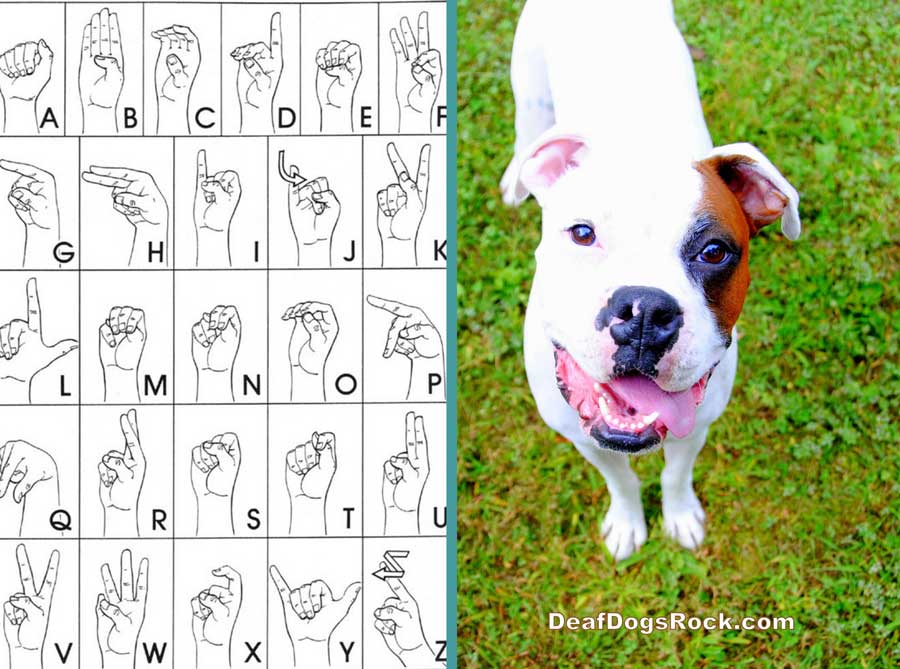
Deaf dogs respond best to hand signals and visual cues. You can use standard American Sign Language (ASL), make your own signs, or a mix of both.
Common Visual Signals
Here are popular hand signals for basic commands:
- Sit: Raise your hand, palm up, and move it upward.
- Stay: Hold your palm out, facing the dog (like a “stop” gesture).
- Come: Sweep your hand toward your chest.
- Down: Point to the ground.
- Good/Yes: Thumbs up or open hand.
- No: Shake your finger side to side.
You can also use flashlights or laser pointers to get your dog’s attention, but never shine a laser directly in their eyes.
Making Your Own System
Some people use simple gestures that feel natural. The key is to be clear and consistent. For example, you might use:
- A big smile and clapping hands for praise
- Tapping your chest for “Come”
- Pointing at the dog’s bed for “Go to bed”
Write down your chosen signals so family members use the same ones. Dogs learn faster when everyone uses the same cues.
Getting Your Deaf Dog’s Attention
Since you can’t call your dog’s name, you need other ways to get their attention. Here are some effective methods:
Touch
Gently tap your dog’s shoulder or back. Always touch in the same place so your dog knows it’s you. Never surprise them with a hard poke.
Vibrations
Stomp your foot on the floor. Many deaf dogs feel the vibration and look toward you.
Visual Signals
Wave your hand, flash the lights, or use a flashlight. Practice this often so your dog learns to look at you when they see these signals.
Vibration Collars
A vibration collar can be a game-changer. When you press a button, the collar vibrates (not shocks). Your dog learns the vibration means “look at me.” Use this only for attention—not as a punishment.
Building A Check-in Habit
Teach your dog to check in with you often. Every time they look at you, reward them with a treat or praise. This builds a habit of looking to you for guidance, which is crucial for safety.
Step-by-step Deaf Dog Training
Training a deaf dog follows the same principles as hearing dogs: reward good behavior, ignore or redirect bad behavior, and be consistent. Here’s how to teach key skills.
Teaching Name Recognition
Even if your dog can’t hear their name, you can teach them to recognize a signal that means “pay attention to me. ”
- Choose a signal (e.g., a wave, flashing the lights, or a gentle tap).
- When your dog looks at you after the signal, immediately give a treat and smile.
- Repeat daily, rewarding every time your dog responds.
- Gradually add distractions and practice in different places.
Sit
- Stand in front of your dog and hold a treat.
- Show the “sit” hand signal.
- Move the treat over your dog’s head. As their head goes up, their bottom will go down.
- The moment they sit, give the treat and a visual “good” sign (like thumbs up).
- Repeat until your dog sits every time you give the signal.
Stay
- Ask your dog to “sit.”
- Show the “stay” signal (palm out).
- Take one step back. If your dog stays, return and reward.
- Increase distance and time slowly.
- If your dog moves, reset and try again.
Come
- Show your “come” signal.
- When your dog moves toward you, reward with treats and praise.
- Practice in a safe, enclosed area.
- Never punish your dog for coming late—it should always be positive.
Down
- Ask your dog to “sit.”
- Hold a treat near their nose, then move your hand down to the floor.
- When your dog lies down, reward immediately.
- Pair the action with your chosen “down” signal.
Leave It
- Place a treat on the floor and cover it with your hand.
- When your dog looks away, show your “leave it” signal and reward with a different treat.
- Practice with more tempting items over time.
Good Behavior Marker
Choose a signal that means “yes” or “good”—like a thumbs up. Use this every time your dog does something you like, so they know they got it right.
Socialization And Life Skills
Training is more than commands. Your deaf dog needs to learn how to be comfortable in the world.
Meeting People And Dogs
Introduce your dog to new people and dogs in safe, controlled settings. Let them sniff and explore at their own pace. Watch for body language: wagging tails, relaxed posture, and gentle approach mean your dog is comfortable.
Handling And Grooming
Teach your dog that being touched is safe. Practice touching their paws, ears, and mouth. Pair each touch with treats and visual praise. This helps with vet visits and grooming.
Handling Startle Responses
Deaf dogs can startle if touched unexpectedly. To reduce this:
- Always approach from the front.
- Wake your dog by gently tapping their bed or blowing on them.
- Reward calm responses to touch.
Over time, most dogs learn that touch brings good things—not fear.
Safety For Deaf Dogs
Safety is the most important part of living with a deaf dog. They can’t hear dangers like cars or alarms. Here’s how to keep your dog safe:
Fencing And Leashes
Always use a leash outside fenced areas. Even well-trained deaf dogs can run into danger if startled or distracted. A fenced yard is best for off-leash play.
Identification
Your dog should wear a tag that says “I am deaf” and your contact info. Microchipping is also highly recommended.
Emergency Signals
Teach your dog an “emergency recall” signal—a special hand wave or flashing the porch light that means “come to me right now. ” Practice this regularly with big rewards.
Walking And Public Spaces
When walking, keep your dog close. Use a harness with a clear “Deaf Dog” patch if possible. Be alert for situations that might surprise your dog, like cyclists or children running up.
Nighttime Visibility
Use reflective collars, harnesses, or LED lights for nighttime walks. Deaf dogs rely on sight—help others see them too.

Credit: deafdogsrock.com
Everyday Life With A Deaf Dog
Living with a deaf dog means adapting some daily routines, but most things are the same as with any dog. Here’s what to expect:
Communication
You’ll use your hands, face, and body more than your voice. Deaf dogs are often more tuned into your mood because they watch you so closely.
Alone Time
Deaf dogs may sleep more soundly and not notice when you leave or return. Establish routines for leaving and returning so your dog feels secure.
Play And Enrichment
Choose toys that make noise you can see (like squeaky toys that vibrate) or that smell interesting. Puzzle toys, scent games, and fetch are all great options.
Travel
Bring your dog’s visual cues and safety gear when you travel. Practice new signals in different environments to build confidence.
Common Challenges And How To Overcome Them
Training a deaf dog is rewarding, but you may face some unique hurdles. Here’s how to handle the most common ones:
Startling And Fear
Deaf dogs can be more easily startled. Help them by:
- Creating positive associations with touch
- Using predictable routines
- Avoiding rough play that surprises them
Getting Attention In Busy Places
Use your vibration collar, wave, or stomp to get their attention in distracting environments. Reward every time they respond.
Recall (coming When Called)
This is the biggest challenge for most deaf dog owners. Practice in safe, fenced spaces first. Use high-value rewards. Never call your dog only for negative things (like bath time)—make coming to you a happy event.
Barking
Some deaf dogs bark more because they can’t hear themselves. Teach a “quiet” signal using treats and calm body language. Reward silence, not barking.
Multi-dog Homes
If you have other dogs, your deaf dog may follow their lead. Use this to your advantage—train all dogs with hand signals to build group communication.
Advanced Training And Fun Activities
Deaf dogs love to learn. Once you’ve mastered the basics, try these fun and advanced activities:
Trick Training
Teach tricks like “shake,” “spin,” or “play dead” using hand signals. Deaf dogs are often quick to learn tricks because they focus visually.
Canine Sports
Many deaf dogs excel in agility, nose work, and rally obedience. These sports rely on visual cues and teamwork. Check local clubs—many welcome deaf dogs.
Scent Work
Use your dog’s strong sense of smell. Hide treats or toys around the house and teach your dog to find them on cue.
Therapy Work
If your dog is calm and loves people, consider therapy dog training. Deaf dogs can be wonderful visitors in hospitals or schools, showing that every dog has value.
Comparing Deaf And Hearing Dog Training
Owners often wonder how much harder it is to train a deaf dog. Here’s a side-by-side look at the main differences:
| Training Aspect | Hearing Dog | Deaf Dog |
|---|---|---|
| Attention Signal | Verbal call/name | Touch, visual, vibration collar |
| Commands | Verbal + visual | Visual only (hand signals) |
| Recall | Easier at distance | Requires line of sight or vibration collar |
| Startle Response | Lower | Higher—needs gentle approach |
| Bonding | Strong | Often even deeper (visual focus) |
What New Owners Often Miss
Even the most dedicated owners can overlook important details. Here are two key insights:
- Dogs watch your whole body, not just your hands. Deaf dogs notice tiny shifts—your eyes, shoulders, posture. Be mindful of your body language; it’s as important as your hand signals.
- Socialization is about more than sound. Expose your deaf dog to sights, smells, and textures. Take them to different places, surfaces, and around people with hats, bikes, or umbrellas. This builds confidence in a hearing world.
Success Stories: Real-life Examples
Hearing from others can inspire and guide you. Here are a few real-life examples:
- Max, a deaf Border Collie: Max’s owner taught him more than 20 hand signals. He excels in agility competitions, watching his handler instead of listening for commands.
- Lily, a deaf Dalmatian: Lily was adopted at six months. Her family uses a vibration collar and bright flashlight signals. She loves hiking and has never run off because she checks in visually every few minutes.
- Milo, a rescue mix: Milo was fearful at first, especially when touched while sleeping. With gentle training, he now wakes up calmly to a gentle bed tap and enjoys cuddles.
These stories show that deaf dogs are not limited—they simply communicate differently.
Credit: deafdogsrock.com
Deaf Dog Training Myths And Facts
There are many myths about deaf dogs. Here are the most common:
- “Deaf dogs are aggressive.” False. Deafness does not cause aggression. Most deaf dogs are as friendly as hearing dogs.
- “You can’t train a deaf dog.” False. Deaf dogs can learn all the same commands using visual signals.
- “Deaf dogs need special trainers.” Not true. Any dedicated owner can train a deaf dog with the right guidance.
- “Deaf dogs should not be off leash.” True in most cases. Deaf dogs are safest in fenced areas unless their recall is flawless and the area is secure.
- “Deaf dogs are unhappy.” Not true. With good training and care, deaf dogs live happy, full lives.
Training Deaf Puppies Vs. Adult Dogs
Is it easier to train a deaf puppy or an adult dog? Both have pros and cons. Here’s a quick comparison:
| Age | Advantages | Challenges |
|---|---|---|
| Puppy | Adapt quickly, open to new cues | Short attention span, more energy |
| Adult | More focus, may know routines | May need to unlearn old habits, possible fear issues |
Both can learn with consistency and love. Adults may need more patience, especially if they lost hearing later in life.
Resources For Deaf Dog Owners
You’re not alone in this journey. There are communities, books, and trainers who specialize in deaf dogs. Some helpful resources include:
- The Deaf Dogs Rock community
- American Sign Language guides (for adapting hand signals)
- Support groups on social media
- Professional trainers experienced with deaf dogs
For more reading, see this guide by the American Kennel Club: American Kennel Club.
Frequently Asked Questions
How Do I Know If My Dog Is Deaf Or Just Ignoring Me?
If your dog does not respond to loud noises, squeaky toys, or their name when behind them, they may be deaf. Try clapping or making a noise out of sight; if there’s no reaction, see your vet for a BAER test.
Can A Deaf Dog Ever Be Let Off Leash?
Usually, it’s safest to keep deaf dogs on a leash unless in a securely fenced area. Even well-trained deaf dogs can get distracted and not see your signals. A vibration collar can help, but safety comes first.
What Are The Best Breeds For Deaf Dog Owners?
Any breed can be deaf, but breeds like Dalmatians, Australian Cattle Dogs, and Boxers have higher rates of deafness. More important is the dog’s personality—look for a dog that is confident, curious, and enjoys interacting visually.
Should I Use A Sign Language System Or Make My Own Signals?
Both work. Some owners use American Sign Language (ASL) for consistency; others create simple, unique gestures. The key is to be consistent and ensure everyone in the family uses the same signals.
Is Training A Deaf Dog More Difficult Than Training A Hearing Dog?
It’s different, not harder. You’ll use more visual and physical cues, and you’ll need to be more aware of your body language. With patience and consistency, most owners find deaf dogs learn quickly and the bond is very strong.
Every dog deserves a chance to thrive, and deaf dogs are no exception. With the right tools, creativity, and love, your deaf dog can live a joyful, well-trained life by your side. Remember—deafness is not a limitation, but an invitation to connect in a new and beautiful way.

Credit: www.whole-dog-journal.com

We’re the dedicated team behind MyPawSafe.com, with over a decade of combined experience in veterinary care, pet emergency response, and animal behavior. While we prefer to let our work speak for itself, our mission is clear: to provide science-backed, vet-approved advice that helps pet owners prevent accidents and save lives.