
Crate Training Schedule For Puppies By Age
Bringing home a new puppy is exciting, but it’s also a challenge. One of the smartest decisions a dog owner can make early on is to use crate training. Crate training helps with housebreaking, keeps your puppy safe, and gives them a secure place to relax. However, many owners struggle with questions like, “How long can my puppy stay in the crate?” or “What should my daily schedule look like at 8 weeks versus 16 weeks?”
A crate training schedule by age gives clear guidance, making the process smoother for both you and your puppy. This article explains how to build a successful schedule, what to expect at each puppy stage, and how to avoid common mistakes. You’ll find sample routines, data-backed recommendations, and tips to help your puppy become a happy, confident member of your family.
Why Crate Training Works
Crate training is much more than just putting a puppy in a box. Dogs naturally seek out small, den-like spaces for comfort and safety. If introduced correctly, the crate becomes your puppy’s favorite retreat, not a punishment.
Benefits of crate training include:
- Faster potty training
- Preventing destructive chewing when unsupervised
- Easier travel and vet visits
- Reducing anxiety by providing a safe space
A well-structured schedule helps your puppy understand when to rest, play, eat, and go potty. It also prevents problems like separation anxiety and excessive barking.
How Long Can A Puppy Stay In A Crate?
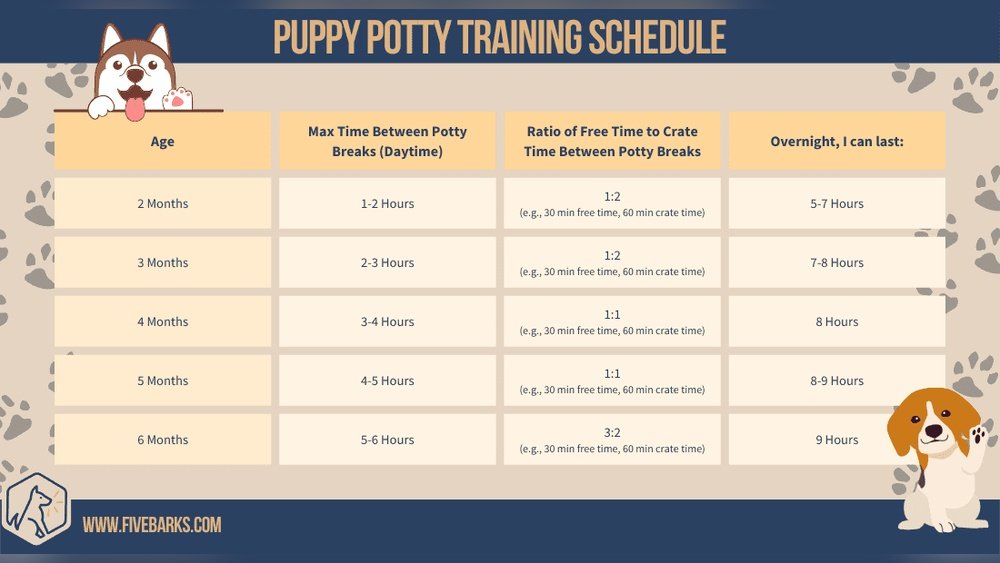
A puppy’s age strongly affects how long they can stay in their crate without discomfort. The general rule is:
Maximum hours in crate = Puppy’s age in months + 1
For example, a 2-month-old puppy can usually handle 3 hours. But this is a guideline, not a guarantee. Some puppies need more frequent breaks, especially for potty needs. Very young puppies (under 10 weeks) should not be left in a crate for more than 1-2 hours at a time during the day.
Here’s a quick reference for safe crate times:
| Puppy Age | Max Time in Crate (Day) | Max Time in Crate (Night) |
|---|---|---|
| 8 weeks | 1-2 hours | 4-5 hours |
| 10-12 weeks | 2-3 hours | 5-6 hours |
| 14-16 weeks | 3-4 hours | 6-7 hours |
| 20+ weeks | 4-5 hours | 7-8 hours |
Important: Every puppy is unique. Watch for signs of discomfort. If your puppy whines, scratches, or has accidents, shorten crate time or adjust your schedule.

Credit: tierparkwolgast.de
Setting Up The Crate For Success
Before starting a schedule, make sure your puppy’s crate is:
- The right size: Your puppy should be able to stand, turn around, and lie down comfortably. Too large and they may potty in a corner; too small and they’ll be stressed.
- Comfortable: Add soft bedding, a safe chew toy, and consider a cover for a den-like feel.
- In a quiet, but not isolated spot: Puppies like to be near family but not in the middle of chaos.
Never use the crate for punishment. Always associate it with positive experiences: treats, meals, and praise.
Crate Training Schedule By Age
The best crate training schedule changes as your puppy grows. Let’s look at what works for each age group.
8–10 Weeks: The Foundation Stage
At this age, puppies have tiny bladders and need lots of sleep—up to 18-20 hours a day. The focus is on short crate sessions, frequent potty breaks, and positive associations.
Sample Schedule (8–10 Weeks)
- 6: 00 am: Potty break right away, then breakfast in crate.
- 6: 30 am: Out for play, supervised.
- 7: 00 am: Crate nap (30–60 mins).
- 8: 00 am: Potty break and short play.
- 9: 00 am: Crate nap (1 hour).
- 10: 00 am: Potty break, play, training.
- 11: 30 am: Lunch, brief crate time while you eat.
- 12: 00 pm: Potty, play, then crate for nap.
- 2: 00 pm: Potty, short play, back to crate.
- 4: 00 pm: Potty, play, training.
- 5: 00 pm: Dinner, crate rest.
- 6: 00 pm: Potty, family time.
- 8: 00 pm: Potty, crate rest.
- 10: 00 pm: Last potty, into crate for the night.
Tip: Set an alarm for a midnight potty break if your puppy is under 10 weeks or having accidents.
Non-obvious insight: At this age, focus on short, frequent crate sessions instead of trying to build long stretches. Puppies develop comfort faster with many positive entries and exits.
What To Watch For
- Whining after a few minutes is normal at first. Wait for a brief pause before letting your puppy out, so they don’t learn whining = freedom.
- If your puppy soils the crate, reduce time between breaks.
- Always give a potty break before and after every crate session.
11–14 Weeks: Building Consistency
Now your puppy can hold their bladder longer (2–3 hours). The schedule can include slightly longer crate naps and more structured playtime.
Sample Schedule (11–14 Weeks)
- 6: 30 am: Potty, breakfast in crate.
- 7: 00 am: Out for play and training.
- 8: 00 am: Crate nap (1–1.5 hours).
- 9: 30 am: Potty, play, short walk.
- 11: 00 am: Crate nap (1–2 hours).
- 1: 00 pm: Lunch, potty, training.
- 2: 00 pm: Crate nap (1–1.5 hours).
- 3: 30 pm: Potty, play, chew time.
- 5: 00 pm: Crate rest (1 hour).
- 6: 00 pm: Potty, dinner, family time.
- 8: 00 pm: Potty, crate rest.
- 10: 00 pm: Last potty, bedtime.
Non-obvious insight: Adding short training sessions before crate time helps puppies burn energy and settle faster.
Progress At This Stage
- Expect fewer accidents, but keep a close eye.
- Gradually increase crate sessions by 15–30 minutes if your puppy is calm.
- Maintain regular meal and potty times—consistency is key.
15–20 Weeks: Increasing Independence
Bladder control improves, and your puppy can handle 3–4 hours in the crate during the day. You can start leaving your puppy crated while running short errands.
Sample Schedule (15–20 Weeks)
- 7: 00 am: Potty, breakfast.
- 7: 30 am: Play, training.
- 8: 30 am: Crate nap (2 hours).
- 10: 30 am: Potty, walk/play.
- 12: 00 pm: Crate rest (up to 2 hours).
- 2: 00 pm: Lunch, potty, chew time.
- 3: 00 pm: Crate nap (1–2 hours).
- 5: 00 pm: Potty, play, training.
- 6: 00 pm: Crate rest (1 hour).
- 7: 00 pm: Potty, dinner, family time.
- 9: 00 pm: Potty, crate wind-down.
- 10: 30 pm: Final potty, overnight crate.
What Changes
- You can experiment with slightly longer crate intervals if your puppy is calm and accident-free.
- Start crate sessions with a chew toy or stuffed Kong to make alone time enjoyable.
- Don’t jump from 2 to 4 hours all at once—add 10–15 minutes each week.
Practical tip: At this age, puppies experience “fear periods.” If your puppy suddenly resists the crate, go back to shorter, positive sessions to rebuild confidence.
5–6 Months And Beyond: Towards Adult Patterns
Most puppies now sleep through the night and can handle 4–5 hours in the crate during the day. Some may still need a midday break, especially for smaller breeds.
Sample Schedule (5+ Months)
- 7: 00 am: Potty, breakfast, play.
- 8: 00 am: Crate (2–3 hours).
- 11: 00 am: Potty, walk, training.
- 12: 00 pm: Crate (2–3 hours).
- 3: 00 pm: Potty, play, chew time.
- 4: 00 pm: Crate (1 hour).
- 5: 00 pm: Potty, dinner, family time.
- 9: 00 pm: Last potty, crate for overnight.
New Challenges
- Teenage puppies may test limits—stay consistent with rules.
- Start leaving the door open when you’re home, so the crate becomes a “choice,” not just a rule.
- Continue using the crate for safe travel, vet visits, or when hosting guests.
Advanced insight: Some puppies develop crate dependency if kept crated too often. Mix crate time with supervised freedom as your puppy matures.
Potty Break Timing And Crate Training
Potty accidents are a top concern with new puppy owners. The right timing can make or break your success.
Best potty break times:
- Immediately after waking
- After eating or drinking
- After play or excitement
- Before and after every crate session
Puppies under 4 months can’t “hold it” for more than 2–3 hours. If you work full-time, consider a pet sitter or arrange for midday breaks until your puppy is older.
Here’s a quick look at average potty frequency by age:
| Puppy Age | Potty Breaks Needed (Daytime) |
|---|---|
| 8–10 weeks | 10–12 times |
| 11–14 weeks | 8–10 times |
| 15–20 weeks | 6–8 times |
| 5–6 months | 4–6 times |
Pro tip: Keep a log of when your puppy eats, drinks, and potties for 2–3 days. Patterns will appear, making scheduling easier.
Nighttime Crate Training
Nighttime brings its own challenges. Young puppies rarely sleep through the night without a potty break. Here’s how to make nights easier for everyone:
- Bedtime routine: Calm play, potty break, then into crate.
- Location: Place the crate near your bed, so you can hear if your puppy wakes.
- No food/water 2 hours before bed: This reduces nighttime accidents.
- Respond to whining, but don’t play: Quietly take your puppy out, then back to crate.
Most puppies can sleep 4–5 hours at 8 weeks, 6–7 hours by 16 weeks, and 7–8 hours by 6 months. If your puppy soils the crate at night, shorten the time or adjust feeding times.
Troubleshooting Common Problems
Puppy Whines In The Crate
Some whining is normal, especially in the first few days. However, if whining continues:
- Make sure potty needs are met.
- Ignore brief whining if you know your puppy is safe and comfortable.
- Reward quiet behavior with treats and praise.
Accidents In The Crate
This often means:
- Too long between potty breaks
- Crate is too big
- Too much water before crating
Clean accidents with an enzyme cleaner to remove odor and prevent repeat accidents.
Puppy Hates The Crate
If your puppy resists entering the crate:
- Use high-value treats for every entry.
- Feed all meals in the crate.
- Play crate games (hide treats inside, toss toys).
- Never force or scold your puppy into the crate.
Excessive Barking
If barking is not from potty needs or fear:
- Give a safe chew or puzzle toy in the crate.
- Cover the crate partially to reduce visual distractions.
- Make sure your puppy is tired before crating.
If barking continues for weeks, consult a professional trainer or vet to rule out anxiety.
Crate Training For Different Breeds And Sizes
Not all puppies are the same. Small breeds often have smaller bladders and need more frequent breaks. Large breeds mature slower mentally but may hold it longer physically.
Examples:
- A Chihuahua puppy at 12 weeks might need a potty every 1.5–2 hours.
- A Labrador Retriever at the same age may last 3 hours.
Adjust your schedule to fit your puppy, not just their age. Some breeds (like Beagles or Huskies) are more vocal and may need extra patience.

Credit: www.infinibandta.org
Gradually Increasing Freedom
Crate training is not just about confinement—it’s about teaching independence. As your puppy matures:
- Gradually increase time outside the crate, supervised.
- Use baby gates or exercise pens to provide safe areas.
- Allow your puppy to nap in the crate with the door open.
Warning: Too much freedom too soon leads to accidents and chewing. Earn trust step-by-step.
Creating A Balanced Day: Crate, Play, And Training
A good puppy day isn’t all crate time. Here’s a balanced approach:
- Crate rest (50–60%): For naps and quiet time.
- Supervised play (20–30%): Training, fetch, walks, chew time.
- Family interaction (10–20%): Cuddles, gentle handling, socialization.
A tired puppy is a happy puppy—and more willing to relax in the crate.
Crate Training Schedule For Working Owners
Many owners worry they can’t crate train because of work. With planning, it’s possible:
- Morning: Early potty, breakfast, play before crate.
- Midday: Arrange for a pet sitter, neighbor, or dog walker to give a potty break and play session.
- Afternoon: Crate again until you return.
- Evening: Focus on play, training, and family time.
If you work long hours, consider doggy daycare or a trusted friend. Crating for 8+ hours is too long for most puppies under 6 months.
Data: Crate Training Success Rates
Research shows that crate-trained puppies are:
- 20–30% faster at housebreaking than non-crated puppies (American Veterinary Society of Animal Behavior)
- Less likely to develop separation anxiety (if crate is used positively)
- Reported by 75% of owners as having fewer destructive behaviors
However, misuse—such as excessive crating or negative associations—can cause anxiety or aggression. Success depends on proper scheduling and positive reinforcement.
Crate Training Schedule Comparison: Common Vs. Optimal
Let’s compare a typical owner’s schedule with an optimal one for a 12-week-old puppy:
| Time | Common Schedule | Optimal Schedule |
|---|---|---|
| 7:00 am | Quick potty, breakfast | Potty, breakfast in crate, play |
| 8:00 am | Crate (3–4 hours) | Crate nap (1–1.5 hours), potty break |
| 11:00 am | Quick potty, back to crate | Play, training, crate nap |
| 2:00 pm | Lunch, play, crate | Lunch, crate nap, supervised play |
| 5:00 pm | Dinner, out of crate for evening | Potty, play, family time, crate rest |
The optimal schedule uses shorter, frequent crate sessions and more structured play breaks, leading to fewer accidents and a happier puppy.
Transitioning Out Of The Crate
By 6–12 months, many dogs can be left safely outside the crate for short periods. Signs your puppy is ready:
- No accidents or chewing for several weeks
- Settles calmly when left alone in a safe room
- Seeks out the crate voluntarily for naps
Transition slowly—start with short sessions outside the crate, then gradually increase. Keep the crate available as a safe space.
Mistakes To Avoid
- Too much crating: Puppies need social time and exercise.
- Negative associations: Never use the crate for punishment.
- Inconsistent schedule: Puppies thrive on routine.
- Ignoring breed differences: Adjust for size and temperament.
- Skipping crate training: Even if you plan to stop using the crate, early training helps with housebreaking and anxiety prevention.
Helpful Tools For Crate Training
- Adjustable crate dividers: Grow with your puppy.
- Enzyme cleaners: Remove urine odor.
- Interactive toys: Keep your puppy busy in the crate.
- Puppy cameras: Monitor crate behavior when away.
For more in-depth guidance, see the American Kennel Club’s recommendations at American Kennel Club.

Credit: www.infinibandta.org
Frequently Asked Questions
How Long Does Crate Training Take?
Most puppies adjust to the crate in 2–4 weeks with a consistent schedule. Some may take longer, especially if they had negative experiences before. Patience and positive reinforcement speed up the process.
Should I Put Food And Water In The Crate?
Food can be used to create positive associations—feed meals in the crate. Water is usually not needed for short crate sessions (under 3–4 hours) but may be offered for longer periods or in hot weather. Remove water 2 hours before bedtime to help prevent accidents.
What If My Puppy Cries All Night In The Crate?
First, check potty and comfort needs. If all is well, ignore brief whining to avoid teaching that noise = attention. Reward quiet moments. If crying is extreme, try moving the crate closer to your bed for reassurance.
Can I Crate My Puppy While I’m At Work?
It’s possible for short periods, but no puppy under 6 months should be crated more than 4–5 hours without a break. Arrange for someone to provide a midday potty and play break. Long periods alone can cause stress and slow training.
Is Crate Training Cruel?
When done correctly, crate training is not cruel. Dogs are naturally den animals. The crate provides safety, structure, and helps with housebreaking. Problems only arise from overuse or negative associations.
A well-planned crate training schedule by age builds the foundation for a happy, well-adjusted dog. With patience, structure, and a focus on positive experiences, your puppy will see the crate as a safe haven, not a prison. Stay consistent, adjust for your puppy’s needs, and celebrate every small success along the way.
We’re the dedicated team behind MyPawSafe.com, with over a decade of combined experience in veterinary care, pet emergency response, and animal behavior. While we prefer to let our work speak for itself, our mission is clear: to provide science-backed, vet-approved advice that helps pet owners prevent accidents and save lives.