
Feeding your dog is more than just filling a bowl. Choosing the right food and feeding amount can change your pet’s life. Royal Canin is a well-known brand trusted by veterinarians and pet owners worldwide. Their nutrition philosophy is based on breed, size, age, and special needs. But with so many choices, feeding guidelines can feel confusing. This complete guide explains how to feed your dog with Royal Canin, customized by breed size and age. If you want your dog to be healthy, energetic, and happy, understanding these feeding steps is important.
You’ll discover how Royal Canin divides foods for different dogs, what makes puppies, adults, and seniors unique, and how much to feed at every life stage. You’ll also learn the difference between small, medium, large, and giant breeds, and why that matters.
We’ll cover feeding tips, common mistakes, and answer the questions many owners ask. With real-life examples, tables, and practical advice, you’ll finish this article confident about how to feed your dog right.
Why Feeding By Breed Size And Age Matters
Not all dogs are the same. A tiny Chihuahua and a massive Saint Bernard have very different needs. Puppies burn energy fast and grow quickly, while senior dogs slow down and need fewer calories. Royal Canin understands that customized feeding helps dogs live longer, healthier lives.
How Dog Size Changes Nutrition
- Small breeds have fast metabolism, need energy-rich food, and often prefer small kibble.
- Medium breeds are active and need a balance of protein, fat, and fiber.
- Large and giant breeds grow slowly, need joint support, and can have sensitive digestion.
Age And Life Stage Differences
- Puppies: Need more calories, protein, and minerals to support rapid growth.
- Adults: Require steady energy and nutrients for maintenance and activity.
- Seniors: Often need less energy, more joint support, and easy-to-digest food.
Ignoring these differences can lead to obesity, poor growth, or even health problems such as joint disease and heart issues.
Understanding Royal Canin’s Feeding Philosophy
Royal Canin is not just about ingredients. It’s about tailored nutrition—each formula is designed for a specific group of dogs, based on science. Here’s what makes their approach different:
- Breed-specific formulas: Some foods are made for a particular breed, like Labrador Retriever or German Shepherd.
- Size-based ranges: Other foods are grouped by dog size: X-Small, Mini, Medium, Maxi, Giant.
- Life stage focus: Each formula addresses the needs of puppies, adults, or seniors.
- Special needs: There are options for sensitive digestion, skin issues, weight management, and more.
Royal Canin invests in research, working with veterinarians and breeders. Their feeding guides are tested in real-world conditions, so you can trust the recommendations.

Credit: www.tractorsupply.com
How To Choose The Right Royal Canin Formula
Choosing the correct formula is the first step. Here’s how you do it:
- Know your dog’s size category: Is your dog X-Small (under 4 kg/9 lbs), Mini (4-10 kg/9-22 lbs), Medium (11-25 kg/23-55 lbs), Maxi (26-44 kg/56-99 lbs), or Giant (over 45 kg/100 lbs)?
- Identify the life stage: Puppy (up to 12-24 months, depending on breed), Adult, or Senior (usually over 7 years).
- Check for special needs: Does your dog have sensitive digestion, allergies, or need weight control?
For example, a 6-month-old Boxer puppy (Medium/Large breed) will need a different food than a 10-year-old Miniature Poodle.
Example: Selecting Food
- Toy Poodle Puppy (2 months, 2 kg): Royal Canin Mini Puppy
- Golden Retriever Adult (3 years, 32 kg): Royal Canin Maxi Adult or Golden Retriever Adult
- Dachshund Senior (10 years, 8 kg): Royal Canin Mini Ageing
Choosing the right formula sets your dog up for the next step: feeding the right amount.
Royal Canin Feeding Guide By Size And Age
Feeding guidelines are based on dog weight, age, and activity level. Royal Canin provides ranges on every bag, but understanding them helps you adjust as your dog changes.
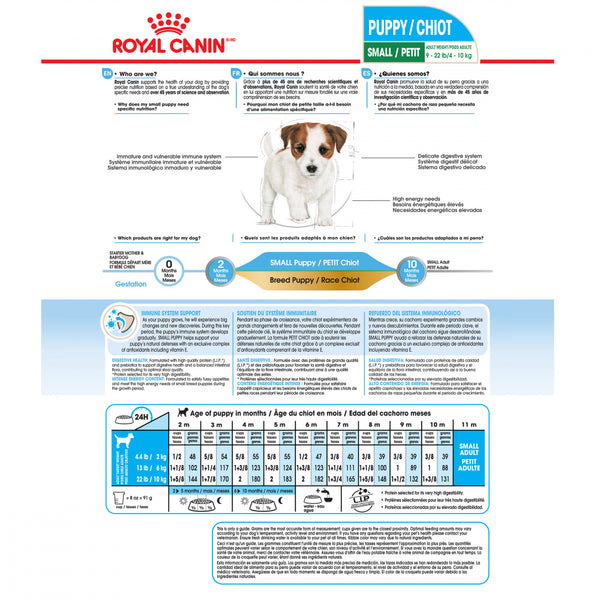
Feeding Small Breed Dogs (mini & X-small)
Small breeds include dogs like Yorkshire Terriers, Chihuahuas, and Dachshunds. They have fast metabolisms and sometimes picky appetites.
Puppy Feeding (up To 10 Months)
Small breed puppies need calorie-dense food to support rapid growth. Feeding amounts change as they grow.
| Age (months) | Weight (kg) | Daily Amount (g) |
|---|---|---|
| 2 | 2 | 49 |
| 4 | 3 | 69 |
| 6 | 5 | 99 |
| 8 | 7 | 126 |
| 10 | 9 | 149 |
Feed 3-4 times per day. Always provide fresh water.
Adult Feeding (10 Months – 8 Years)
Adults need steady energy, not as many calories as puppies. They can become overweight if overfed.
- 2 kg dog: 40g per day
- 5 kg dog: 85g per day
- 8 kg dog: 120g per day
Adjust for activity. Active dogs may need up to 20% more, while couch potatoes need less.
Senior Feeding (8+ Years)
Senior small dogs slow down and may develop dental or digestive issues. Royal Canin Mini Ageing is softer and supports kidney health.
- 2 kg dog: 35g per day
- 5 kg dog: 75g per day
- 8 kg dog: 110g per day
Split meals into two servings for comfort.
Feeding Medium Breed Dogs
Medium breeds include Cocker Spaniels, Border Collies, and Bulldogs. They balance energy needs with a risk of weight gain.
Puppy Feeding (up To 12 Months)
Medium puppies grow quickly but are less fragile than small breeds.
| Age (months) | Weight (kg) | Daily Amount (g) |
|---|---|---|
| 2 | 8 | 109 |
| 4 | 12 | 146 |
| 6 | 16 | 188 |
| 8 | 20 | 225 |
| 12 | 25 | 275 |
Feed 3 times a day until 6 months, then move to 2 meals.
Adult Feeding (12 Months – 7 Years)
- 15 kg dog: 190g per day
- 20 kg dog: 230g per day
- 25 kg dog: 270g per day
More active dogs get more food. Watch weight and adjust.
Senior Feeding (7+ Years)
Medium seniors may slow down and need easy-to-digest formulas.
- 15 kg dog: 170g per day
- 20 kg dog: 205g per day
- 25 kg dog: 240g per day
Divide food into 2-3 small meals for comfort.
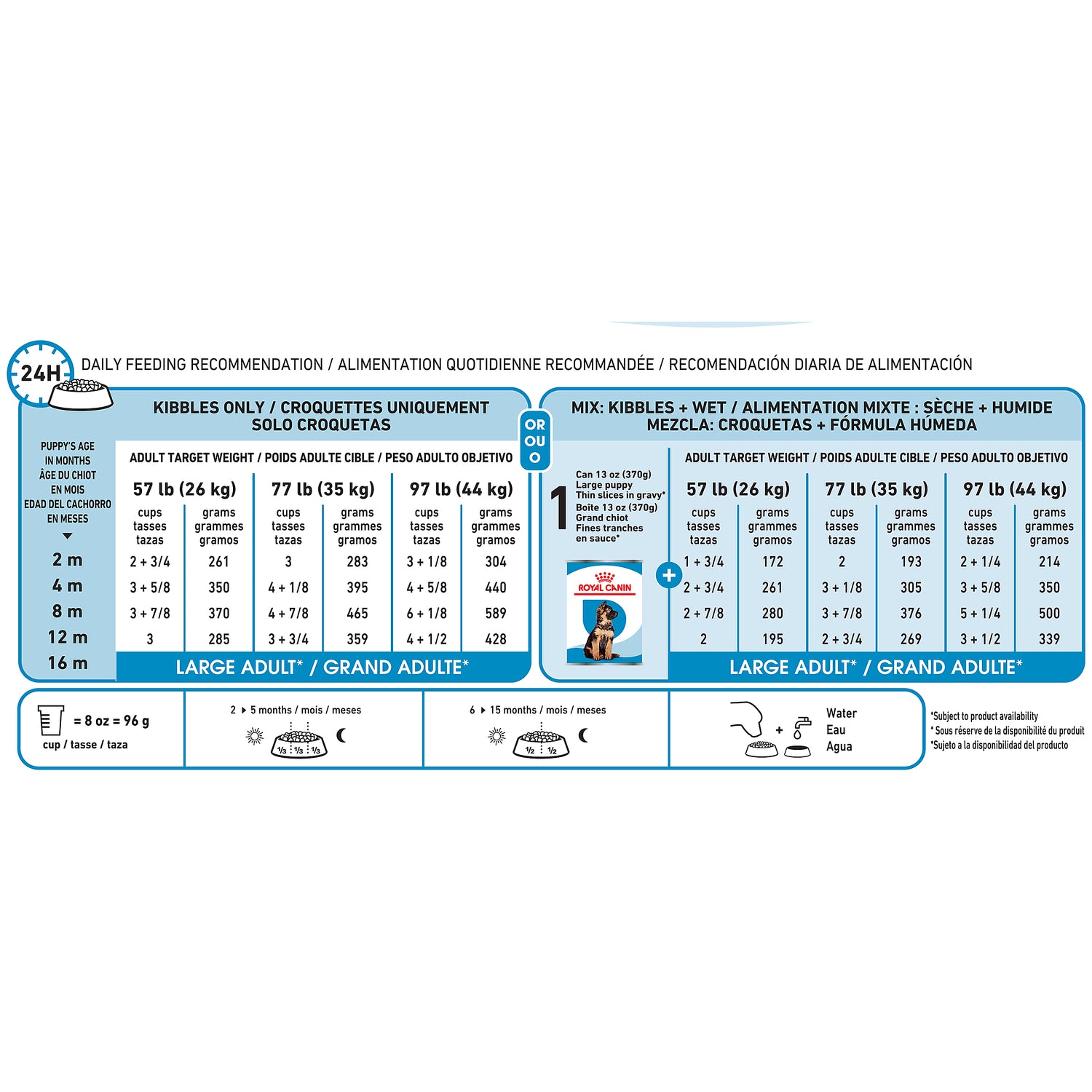
Feeding Large Breed Dogs (maxi)
Large breeds include Golden Retrievers, Labrador Retrievers, and German Shepherds. They grow slowly, are prone to joint issues, and can overeat easily.
Puppy Feeding (up To 15-18 Months)
Large breed puppies need controlled calories to avoid rapid growth.
| Age (months) | Weight (kg) | Daily Amount (g) |
|---|---|---|
| 2 | 15 | 174 |
| 4 | 22 | 237 |
| 6 | 30 | 307 |
| 9 | 38 | 355 |
| 12 | 45 | 394 |
Feed 3 times a day for puppies under 6 months, then 2 times a day.
Adult Feeding (15/18 Months – 5 Years)
- 30 kg dog: 340g per day
- 40 kg dog: 410g per day
- 50 kg dog: 470g per day
Reduce for less active dogs. Prevent weight gain to protect joints.
Senior Feeding (5+ Years)
Large breed seniors need lower calories and joint support (glucosamine, chondroitin).
- 30 kg dog: 300g per day
- 40 kg dog: 365g per day
- 50 kg dog: 420g per day
Split food into 2 meals to prevent bloat and discomfort.
Feeding Giant Breed Dogs
Giant breeds include Great Danes, Saint Bernards, and Newfoundlands. Their size brings unique nutrition needs.
Puppy Feeding (up To 24 Months)
Giant puppies grow for up to two years! They need special formulas to avoid joint stress.
| Age (months) | Weight (kg) | Daily Amount (g) |
|---|---|---|
| 2 | 20 | 223 |
| 4 | 35 | 315 |
| 8 | 55 | 440 |
| 12 | 70 | 510 |
| 18 | 80 | 540 |
Feed 3 meals up to 6 months, then 2 meals per day.
Adult Feeding (24 Months – 5 Years)
- 60 kg dog: 570g per day
- 70 kg dog: 630g per day
- 80 kg dog: 680g per day
Giant dogs eat a lot but need food that’s not too energy-dense to prevent obesity.
Senior Feeding (5+ Years)
Giant seniors have a higher risk of arthritis, heart, and digestive issues.
- 60 kg dog: 510g per day
- 70 kg dog: 565g per day
- 80 kg dog: 610g per day
Always split into at least 2 meals. Watch for weight gain and slow movement.
Feeding Guide For Breed-specific Royal Canin Foods
Some breeds have unique needs. Royal Canin makes foods for breeds such as Labrador Retriever, Shih Tzu, Bulldog, and German Shepherd. These foods have special kibble shapes, nutrients, and flavors.
Example: Labrador Retriever
Labradors are prone to weight gain. Their formula has lower calories and supports joints.
- Puppy (2-15 months): 260-400g per day (split into 3 meals)
- Adult (15 months – 5 years): 300-395g per day
- Senior (5+ years): 265-350g per day
Example: German Shepherd
German Shepherds can have sensitive digestion. Their food contains highly digestible proteins and extra fiber.
- Puppy (2-15 months): 265-405g per day
- Adult (15 months – 5 years): 350-480g per day
- Senior (5+ years): 300-400g per day
Example: Shih Tzu
Shih Tzus have small jaws and long hair. Their kibble is tiny and supports skin health.
- Puppy (2-10 months): 50-85g per day
- Adult (10 months – 8 years): 60-95g per day
- Senior (8+ years): 55-90g per day
Breed-specific formulas are not just marketing—they can help with common breed problems.
How To Adjust Feeding Amounts
The guide on your Royal Canin bag is a starting point. Every dog is different. You may need to adjust feeding for:
- Activity level: Working and sporting dogs need more calories.
- Neutering/spaying: Can reduce calorie needs by 20%.
- Climate: Dogs in cold weather may eat more.
- Health issues: Illness can affect appetite and needs.
How To Tell If You’re Feeding The Right Amount
Use the Body Condition Score (BCS) method. Look for:
- Ribs easy to feel but not see
- Waist visible from above
- Belly tucked up from side
If your dog gains weight, reduce food by 10%. If losing weight, increase by 10%. Weigh your dog monthly.
Wet Vs. Dry Food: Which To Choose?
Both have benefits. Royal Canin offers both types.
- Dry food (kibble): Cleans teeth, easy to store, cheaper per meal.
- Wet food (cans, pouches): More moisture, tasty for picky eaters, good for seniors with dental problems.
Many owners mix both for variety.
Mixing Wet And Dry: How To Do It
Feed half the daily calories from dry, half from wet. For example, if your 10 kg adult dog needs 170g of dry food, you can feed 85g dry and one can of wet.
Practical Feeding Tips For Every Dog Owner
Some feeding strategies make a big difference, no matter your dog’s breed or age.
- Measure food with a scale or cup—guessing leads to overfeeding.
- Feed at the same times each day for routine.
- Don’t leave food out—if your dog doesn’t finish in 20 minutes, remove the bowl.
- Clean bowls daily to prevent bacteria.
- Don’t feed table scraps—they add calories and can upset digestion.
- Monitor stool quality—soft or hard stools can mean you need to adjust food type or amount.
Credit: shop.royalcanin.ca
Common Feeding Mistakes And How To Avoid Them
Many owners make simple mistakes that can harm their dogs. Here are the most common—and how to avoid them.
Overfeeding
Royal Canin’s foods are nutrient-dense. Giving “a little extra” leads to rapid weight gain, especially in small or senior dogs. Always measure carefully and adjust as your dog’s activity changes.
Ignoring Life Stage Changes
Puppies, adults, and seniors have very different needs. Feeding puppy food to an adult can cause weight gain. Switching too late can delay growth or cause digestive upset.
Free Feeding
Leaving food out all day (“free feeding”) often causes obesity, especially in indoor dogs. Scheduled meals help prevent this.
Sudden Food Changes
Switching formulas quickly can cause diarrhea. Transition over 5-7 days by mixing old and new food.
Not Checking For Health Changes
Dental problems, arthritis, or slow movement can change food needs. Check with your vet if you notice changes in appetite, activity, or weight.
Special Situations: Feeding For Health Needs
Royal Canin also offers foods for special health situations. Your vet may recommend these if your dog has certain conditions.
- Weight control: For overweight dogs, use Royal Canin Satiety or Weight Care.
- Digestive issues: Gastrointestinal formulas support sensitive stomachs.
- Skin allergies: Hypoallergenic or Skin Support diets help.
- Joint support: Mobility formulas contain extra omega-3 and joint nutrients.
Never switch to a veterinary diet without advice from your veterinarian.
How To Read And Use The Royal Canin Feeding Chart
Every Royal Canin bag or can has a feeding chart. Here’s how to use it:
- Find your dog’s current weight (use a scale).
- Check age and activity level.
- Read the daily amount in grams or cups.
- Divide into meals (2-3 per day, more for puppies).
- Adjust over time as your dog grows or ages.
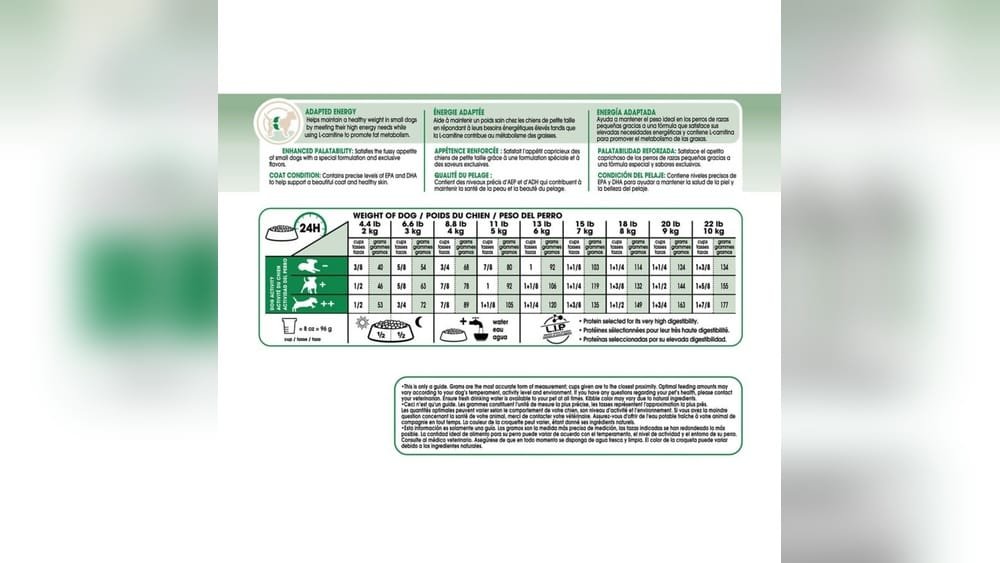
Sample Feeding Chart For Royal Canin Medium Adult
| Dog Weight (kg) | Low Activity (g) | Moderate Activity (g) | High Activity (g) |
|---|---|---|---|
| 11 | 143 | 166 | 189 |
| 15 | 183 | 212 | 241 |
| 20 | 227 | 264 | 301 |
| 25 | 268 | 314 | 360 |
If you’re unsure, contact your vet or Royal Canin’s support team.
Transitioning Your Dog To Royal Canin
Switching foods should be done slowly to avoid digestive upset.
- Days 1-2: 75% old food, 25% Royal Canin
- Days 3-4: 50% old food, 50% Royal Canin
- Days 5-6: 25% old food, 75% Royal Canin
- Day 7+: 100% Royal Canin
If your dog has diarrhea or refuses to eat, slow down the transition.
Credit: www.petsense.com
Real-world Examples And Insights
Case Study 1: Small Dog (miniature Schnauzer)
Bella, a 5 kg Miniature Schnauzer, started gaining weight at age 7. Her owner switched her from Royal Canin Mini Adult to Mini Ageing and reduced daily food from 85g to 70g. Within two months, Bella returned to a healthy weight and was more playful.
Case Study 2: Giant Breed (great Dane)
Max, a 70 kg Great Dane puppy, was growing too fast on regular food. His vet switched him to Royal Canin Giant Puppy, feeding 500g per day split into three meals. Max’s growth slowed to a safe rate, and he avoided joint problems common in his breed.
What Many Owners Miss
- Kibble size matters: Small dogs prefer tiny kibble, while large dogs need larger pieces to chew.
- Water is key: Dogs on dry food need more water. Dehydration can lead to kidney issues.
- Feeding charts are guides, not rules: Your dog’s needs can change with weather, stress, or exercise.
How Royal Canin Compares To Other Brands
Royal Canin stands out for its science-based, breed- and size-focused approach. Unlike “all life stages” foods, Royal Canin formulas are customized. Other brands may offer fewer choices, and not all have breed-specific options.
- Nutrient balance: Royal Canin carefully controls protein, fat, and minerals for each dog type.
- Unique kibble shapes: Help with chewing and dental health, especially for breeds with special jaw shapes.
- Supported by research: Royal Canin partners with veterinarians and universities worldwide (Royal Canin Scientific Research).
Frequently Asked Questions
How Do I Know Which Royal Canin Formula Is Best For My Dog?
Choose based on your dog’s size, age, and any health needs. Royal Canin’s packaging and website help you match the right food. If your dog is a specific breed, consider the breed formula. When in doubt, ask your veterinarian.
Can I Switch Between Wet And Dry Royal Canin Food?
Yes, you can use both. Many owners mix wet and dry food. Just make sure the total calories match your dog’s needs. Mixing can encourage picky eaters and add variety.
How Often Should I Feed My Dog?
- Puppies: 3-4 meals per day (up to 6 months)
- Adults: 2 meals per day
- Seniors: 2-3 smaller meals per day
Regular meal times help digestion and prevent overeating.
What If My Dog Is Overweight?
Switch to a weight management Royal Canin formula, reduce daily food by 10-20%, and increase exercise. Monitor your dog’s weight monthly. If you’re not seeing results, talk to your vet about a personalized plan.
Is Royal Canin Suitable For Dogs With Allergies Or Sensitive Stomachs?
Yes, Royal Canin offers special hypoallergenic and sensitive digestion formulas. These use selected proteins and easy-to-digest ingredients. Always consult your veterinarian before switching to a veterinary diet.
Your dog’s health and happiness depend on what you feed every day. By understanding breed size, age, and Royal Canin’s science-based approach, you can give your dog the best possible nutrition. Remember, every dog is unique, so watch your pet, adjust as needed, and enjoy the journey together.

We’re the dedicated team behind MyPawSafe.com, with over a decade of combined experience in veterinary care, pet emergency response, and animal behavior. While we prefer to let our work speak for itself, our mission is clear: to provide science-backed, vet-approved advice that helps pet owners prevent accidents and save lives.